Elon is a trillionaire, and you’re not. But nuclear clocks are a thing.


Elon is a trillionaire, and you’re not. That’s ok (honestly). It’s not great – but it’s not terrible, either.
While you’re on board with a workaholic making more money than anyone or not, you can’t disregard his achievements. PayPal, Tesla, and SpaceX are just a few. But he isn’t the only one making waves. Did you hear about the nuclear clock?
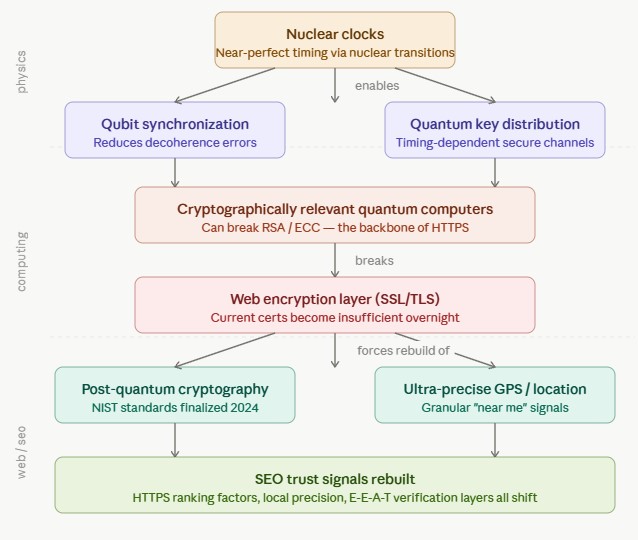
Similar to atomic clocks, the nuclear clock uses isotope thorium-229 to keep time, possibly doing a better job than these atomic clocks. Why does this matter? You’ve seen how fast technology progresses. Heck, even the things Elon is tinkering with could potentially benefit from a super accurate timing device.
Elon and nuclear clocks are nice, but how does this affect you? Well, if you’re reading this it is likely you have some interest in websites, how to get them to rank better, and all that. Technology like this extends to things like quantum computing which are extremely sensitive to timing. It feels like as soon as a Qubit appears, it’s gone. Like a flash. Once that isn’t so much of an issue, cryptography gets a lot easier. Unfortunately, this also includes your website’s SSL certificate.
Most of a website’s security infrastructure contains protocols like HTTPS and SSL/TLS certificates. These are trust signals that Google uses to rank websites and they are based on encryption algorithms like RSA and ECC. These quantum computers will eventually break through.
We’re not done. These neat nuclear clocks could enable GPS and location timing so precise, that hyperlocal search signals become way more accurate. You know, those “near me” keywords? Instead of a few blocks, how about a few meters? We may find more of a shift towards the impact of these “near me” keywords like “Chinese food near me” or “divorce lawyer near me” (hopefully these terms are not related!)
So how do we look ahead? Well, if your website doesn’t have a security certificate (SSL/TLS) then you need to get one, like yesterday. Visit your website and check the button next to the URL, often there will be a lock or something similar to say your website is secure. These certificates are getting pretty strict and need to be renewed more often than ever before. The next thing is to make sure your website is lightening fast and contains very obvious signals to Google of where your business is located and the areas it serves. Maps, schemas, FAQs, all that stuff.
We’re not all built like Elon, but it doesn’t mean we can’t prepare for what’s to come. There’s some cool things on the horizon, let’s embrace it.